"Endurance is more than pacing up and down within the cell of our circumstance;
it is not only acceptance of the things allotted to us, it is...magnifying what is allotted to us."

~Neal A. Maxwell

Showing posts with label obligation. Show all posts

Saturday, June 4, 2011

The End of an Experiment

I held out for well over a year, but finally decided to surrender and hire help again.  This is the first Saturday morning in a long time I haven't spent cleaning my house.  (Of course, I'm doing a mountain of laundry, but that's life.  I'm waiting for the day we all wear disposable clothes like in The Uglies series by Scott Westerfeld.)  Do you think it's okay to keep the green handbag?  

StumbleUpon.com

Monday, September 13, 2010

Can We Play Rock, Paper, Scissors?

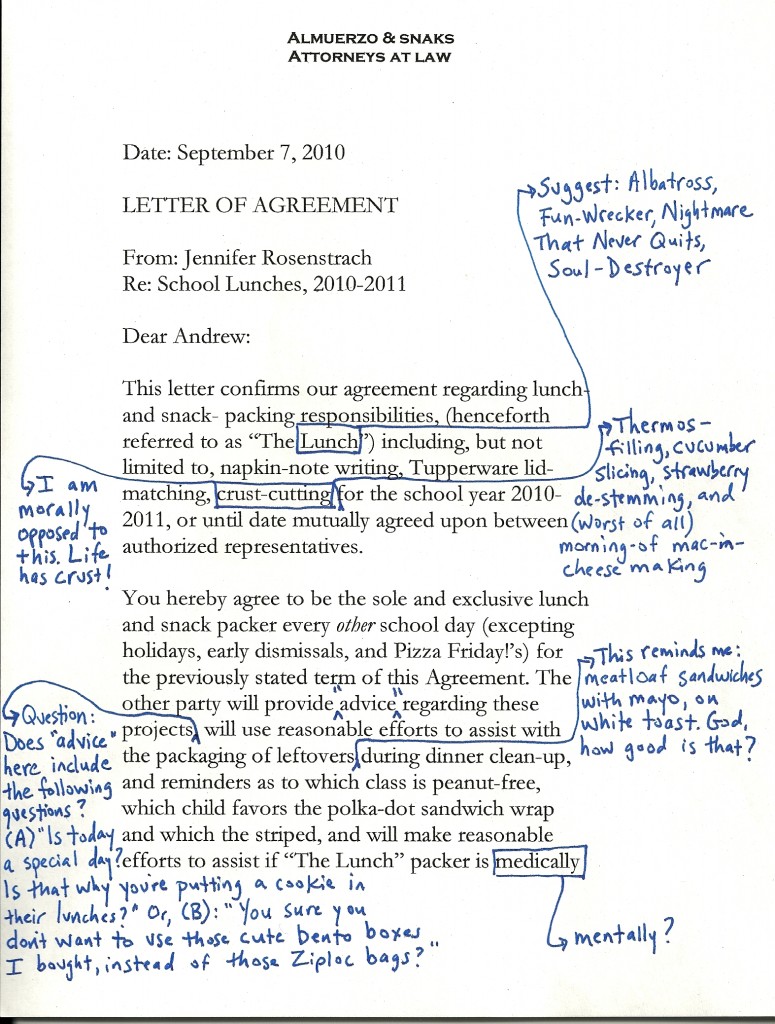
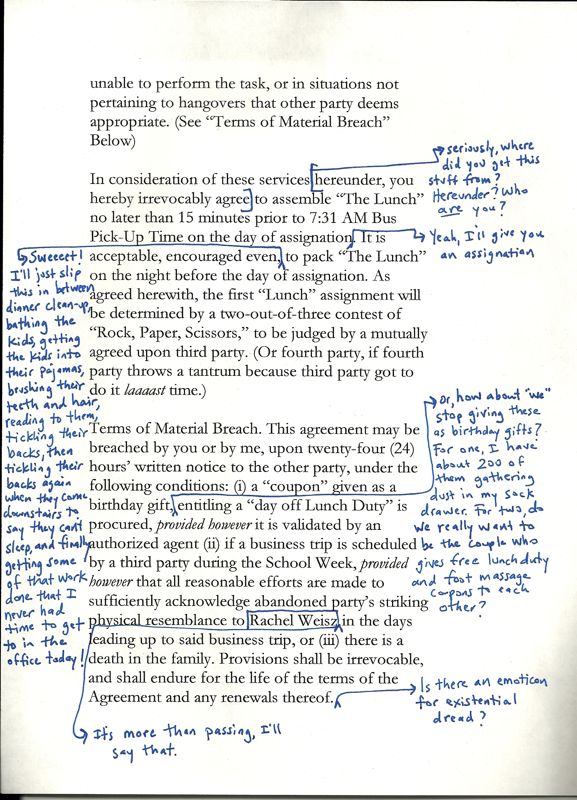
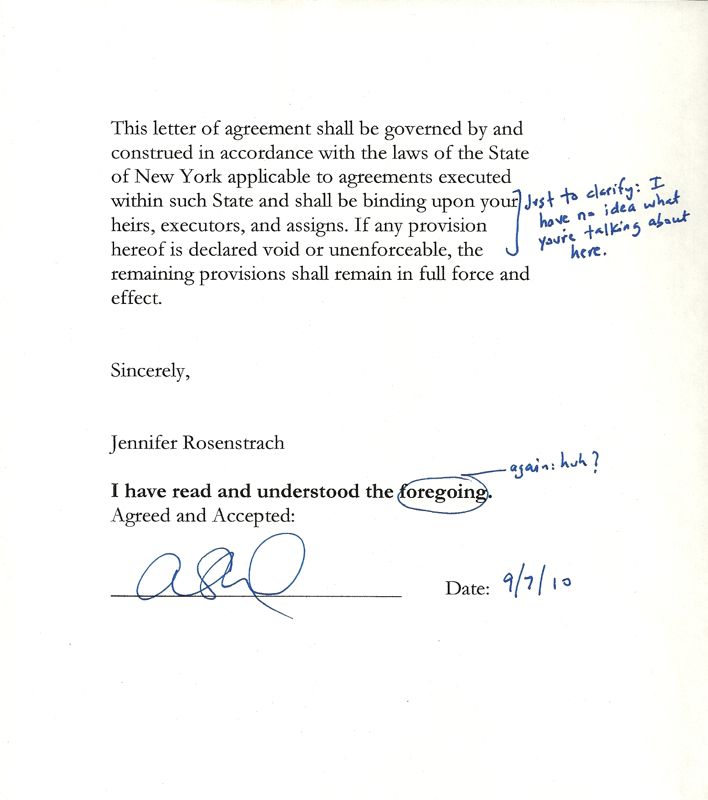
Just had to share this "letter of agreement" between wife and husband re school lunches for 2010-2011.  I was nearly crying with laughter, and I almost never find anything that amusing.  If I could just get my husband to agree to divvy up responsibilities with a good game of rock, paper, scissors, I think I'd be a lot better off than I am now.  I mean, how many times can his rock crush my scissors, or his paper cover my rock, or his scissors cut my paper?

{This comes from Dinner: A Love Story, a blog I quite enjoy.}


StumbleUpon.com

Tuesday, September 7, 2010

Picture Day

Here is a no-doubt incomplete list of things I was supposed to remember this morning, all before the 7:35 a.m. school drop off:

  1. One child's library books are due on Mondays, while the other child's books are due on Fridays.  Is Tuesday the new Monday this week given that Monday was Labor Day?  No idea.  (In fact, we scrambled for no reason because Tuesday is NOT the new Monday when it comes to library day.)
  2. One child has PE on Mondays and Thursdays, and the other has PE on Tuesdays and Fridays.  They must wear proper shoes on such days or be subjected to shame.  See number 1.  Is Tuesday the new Monday?  
  3. The PTO fundraiser order packets are due today.  According to my older daughter, it is essential that I turn in the packets even though I'm too cheap to purchase the unnecessary wares they're peddling.  If I don't, her class will not have a popcorn party, and it will be ALL MY FAULT.
  4. One child wants blackberries in her lunch and the other absolutely does not.  (Note to self, do not ever send blackberries again, because child who insisted on them proceeded to irreparably stain her shorts with the berry juice and then cried inconsolably, which prompted her teacher to then ask each and every teacher in the school if she/he had a stain remover stick she could use to get the berry juice off my daughter's behind.  I know, because her teacher emailed me about the episode.)
  5. One daughter has snack time, and the other does not.  If I pack a snack for the wrong one, I'll either have a daughter relying upon the charity of others, or a daughter getting in trouble with her teacher for trying to sneak a snack when no such time for snacking is designated.  
  6. One daughter needs three different colors of apples for an "autumn" school project, and no I can't color them with a marker.  Red, yellow, green.  Like a traffic light.  
  7. PICTURE DAY.  I especially appreciated the curbside sign as I pulled into the parent drop off area:  "Remember, today is picture day!"  Given that there are seriously intent traffic-directing-ladies with big foam pointing-finger gloves saying "pull all the way forward" -- no stopping, no waiting, no kissing your children goodbye -- how am I supposed to prepare my children for picture day at that late juncture?  Little bit late for an information-overloaded mother, don't you think?  
In the spirit of picture day, here are some really bad photos that are pretty funny:  http://www.huffingtonpost.com/2010/08/04/bad-yearbook-photos-colle_n_670505.html

StumbleUpon.com

Monday, August 2, 2010

Ask Not What Your Mother Can Do for You

Soft and Clean by Leslie Graff
I was never going to be that mother.  You know the type.  The kind that chides disobedient children with "Just wait until your father gets home."  I was going to be a force to be reckoned with in my own right -- never one to admit weakness by calling in the reinforcements.  Well, I'm ashamed to admit that I have resorted to the tactic in desperate moments.  

On Saturday, I had pretty much had it already by 10 a.m.  I was still in my pajamas, flitting from room to room in my efforts to clean the house while dealing with a million requests from children who were more hinderance than help.  "Mom, I'm bored!  What can I DO?!"  "Mom, I'm thirsty."  "Mom, I'm hungry."  "Mom, [brother/sister] is bothering me!"  "Mom, I need help to wipe."  "Mom, I don't know what to wear; come choose my clothes."  "MOM, help me NOW!"  So, I did it.  I called my husband downstairs (he was working in the office upstairs) and told him he had to talk to them.  What he said was actually quite good.

Let me first say, that it completely irks me that they will listen to him in rapt and respectful silence, when I seem to be received more like sound and fury signifying nothing.  But irritation aside, I was impressed. He told them they are treating me like Cinderella.  They pepper me with their demands and act as if I'm their servant.  Instead of "Mom, I need something to eat!" try asking "Mom, are you hungry?  Would you like me to get you something to eat?"  Instead of "Mom, I'm bored!" try "Mom, what can I do to help you?"

Folding clothes from the other room while eavesdropping on the speech, I couldn't help thinking of John F. Kennedy's 1961 Inaugural Address, where he offered the now-famous suggestion:  "Ask not what your country can do for you -- ask what you can do for your country."  My children did indeed need such a speech.  Maybe your children do too.  Now I will take the opportunity from time to time to remind them to ask not what their mother can do for them, but rather what they can do for their mother.

And the beautiful thing?  The speech WORKED.  At least for a little while . . . .    

StumbleUpon.com

Wednesday, June 30, 2010

Wednesday's Word -- Guilt


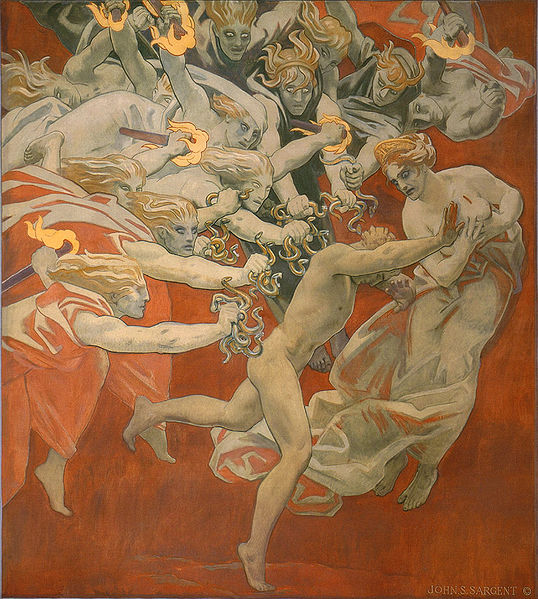
File:Singer Sargent, John - Orestes Pursued by the Furies - 1921.jpg
Orestes Pursued by the Furies, by John Singer Sargent, 1921.  The erinyes represent the guilt for murdering his mother.  

It took 43 seconds for the elevator doors in my office building to open and let me in this afternoon.  I know, because I count.  It's not so much that I'm impatient (although I am).  I count because I desperately want to dive into the elevator before anyone at work sees me leaving while it's still afternoon.  


You'd think I'd dispense of such emotions given the number of insanely committed years I've devoted, and the significant fact that I've taken a major paycut in exchange for the right to walk out the door.  But that doesn't stop me from feeling guilty about it.  Crazy, but true.  And the sad reality is that I feel guilty about leaving, and I feel guilty about staying.  Either way, I feel like I'm letting people down.  Family or work -- take your pick.    

Guilt
The word guilt comes from the Old English gylt meaning "crime, sin, fault."  Gylt is of unknown origin, but some think it may have a connection with the Old English gieldan meaning "to pay for, debt."  I kind of like that, because that's sure how I feel -- like everyone wants something from me and there's no way to satisfy them.  Perhaps a pound of flesh?  

For now, I'll keep counting at the elevator, trying to outrace the needless guilt that pursues me.

StumbleUpon.com

Monday, May 24, 2010

Them Bones, Them Bones, Them Vegetable-Made Bones

Oh the things you can learn about me by reading my bulletin board.  This old favorite made me smile today as I jerk my lumbering plow along in spite of every obstacle.


Keep plodding!

StumbleUpon.com

Wednesday, May 19, 2010

Wednesday's Word -- Sabbatical

Today's word is inspired by my life.  Well actually, pretty much every word I ever choose is inspired by my life, but this is a word currently near and dear to my heart.  

Sabbatical

The word "sabbatical" means "of or appropriate to the Sabbath; pertaining to a sabbatical year; bringing a period of rest; any extended period of leave from one's customary work."  Another dictionary defines it as "an extended period of leave, once every seven years and often one year long, taken by an employee in order to carry out projects not otherwise associated with the employee's job."  

"Sabbatical year" means "a year, usually every seventh, of release from normal duties."  To the Jews it was a yearlong period once every seven years, during which all agricultural labors are suspended.  (See Leviticus 25.)  The idea was that the field would produce a better crop if given a chance to rest.   

"Sabbath" is the seventh day of the week, set aside as a day of rest.     

So, after 13 long years of hard work as a lawyer, I have finally qualified for a three-month sabbatical.  Never mind that the fact that it took 13 years and will last only 3 months flies in the face of the meaning of the word sabbatical.  I was scheduled to be on sabbatical from May through July 2010, but then it crept to June through August, and now (alas), this period of rest will last only 21 days, because I can't swing a 3 month rest right now.  

But I will make those 21 days count as best I can.  I will suspend my normal labors and take leave from my customary work.  I will carry out projects not associated with my job.  We leave for Europe (with three young kids in tow) on Tuesday morning.  If you're interested, you can read about our trip preparation and (I hope, international internet connections allowing) some of our adventures in the Mediterranean, here.    

For now, here's a quote from the ancient poet Ovid that I just love:

"Take a rest; a field that has rested gives a bountiful crop."

StumbleUpon.com

Monday, May 3, 2010

Hobson's Choice -- Take That or None

Today, I'm sharing more wisdom from my bulletin board.  

Thomas Hobson owned a livery stable in Cambridge, England in the early 1600s.  Hobson's stable was filled with many horses of different varieties.  But when a customer came in to rent one, Hobson offered the customer the choice of either taking the horse nearest the stable door, or taking none at all.  This was his method for rotating his horses.  

Thus the phrase "Hobson's choice" came to mean the choice of taking either that which is offered, or nothing.  You have freedom of choice, but there's only one choice.

[This incidentally reminds me of a book I read recently (another excellent book provided by my sister Becky) called The Mysterious Benedict Society, by Trenton Lee Stewart.  In the book, several very bright children go on a secret mission, undercover, at the Learning Institute for the Very Enlightened (LIVE).  The only rule at the school is that there are no rules.  In reality, there are all sorts of absurd "non"-rules.  For example, you're allowed to keep the lights on in your rooms as late as you wish until ten o'clock each night.  Freedom to choose one choice.]  

My life is filled with Hobson's choices, or at least it feels that way.  Right now, I'm chewing on a choice presented to me at the stable of life today.  But the longer I chew, the more I fear that I have no choice at all.  I fear that there is only one horse available to me, and I must continue to ride it.  (No, the horse is not a person.)

I'm all for freedom of choice.  It just irks me when the choices are illusory.  I must admit that I offer Hobson (or nearly-Hobson) choices to my children all the time.  "We don't want to take baths!"  "Okay then.  I'll give you a choice.  You can take a bath in the upstairs tub.  Or you can take a bath in the downstairs tub."  (Either way, they are taking baths and have no choice in the matter.)  It's effective with children, and I suppose it's effective with me too.    

Well, this may be cold comfort, but one could argue that choices galore actually make us unhappy.  Here's one good book that takes up the question.      

StumbleUpon.com

Wednesday, April 14, 2010

Wednesday's Word -- Virtual

I was struck today by how virtual my life is.  I can't even count how many meetings (most of them telephonic and/or by live web meeting) I packed into my day today (all before zooming off at 2:45 pm to pick up my kids).  My common refrain throughout my days is "I could meet between X and Y, but I'm booked with meetings after Z."  (I will admit here that at least some of my "meetings" are with three little, but very demanding people, aka my children.)  As I was sitting in one of the meetings (a 7 a.m. conference call with a client's employees located on several different continents), I decided on the word "virtual" as my word for the day.


Virtual is an adjective meaning "being such in force or effect, though not actually or expressly such"; "temporarily simulated"; a "mirror" image.  The word virtual tends to be used in reference to things that mimic their "real" equivalents.  My favorite definition is this:

"That which is not real,
but may display the salient qualities of the real."  

This makes me think of Shakespeare's Macbeth:

Life's but a walking shadow, a poor player
That struts and frets his hour upon the stage
And then is heard no more: it is a tale 
Told by an idiot, full of sound and fury,
Signifying nothing.

So many of the things I concern myself with on a day-to-day basis are only pretending to be real, displaying the salient qualities of the real -- a walking shadow.  (By the way, "salient" is a cool word too.  It means "prominent or conspicuous," but also means "leaping or jumping."  I like to visualize aspects of my life leaping and jumping about in urgency, pretending to be important when they actually are not.)

Breaking the word "virtual" down, it comes from the word "virtue" and the Latin virtus, meaning "excellence, potency, efficacy."  Virtue means "conformity of one's life and conduct to moral and ethical principles."  Just as a virtual reality doesn't match true reality, our conduct usually doesn't match the "virtue" we aspire to.  Interestingly, the word virtue comes from an Indo-European root meaning "man."  So virtue is literally "manliness, manhood."  (Brings new meaning to Proverbs 31:10:  "Who can find a virtuous woman?  For her price is far above rubies," doesn't it?)  


With all this etymological information to consider, my bottom line thought is this.  I want to spend more of my life living in the real and not in the substitute for the real.  And I'm not really talking about living immersed in technology instead of in actual life (although that's also a very interesting topic.  Just think of all the teenagers who won't have the social skills to converse with a real live person because they were too caught up "speaking in thumbs" with their text messaging . . . .)  


My point is much simpler.  Too often, I appear to be in the moment, but am not.  I am a player, strutting and fretting my hour upon the stage.  This applies to all my roles and responsibilities, in all my spheres, but particularly to my home life.  When I'm with my children, I want to be with my children.  Less virtual mom, and more real and present mom.  Easier said than done, when all the "salient qualities of the real" won't leave you alone!         

StumbleUpon.com

Friday, April 2, 2010

Lightening Your Load {and regretting it}

Have you ever thrown something away, only to find yourself in desperate need of that very item a week later?  That sort of thing seems to happen to me with some frequency.  Of course you had zero need of the thing for the year it was sitting untouched and neglected in your junk drawer or hall closet.  But that's the way it goes.

Have you ever cast aside some aspect of yourself, only to regret it later?  It won't be the next week or the next month, and maybe not even the next year.  It takes longer.  But have you ever taken a hard, long look at yourself and missed the you you used to be?  It happens.

I have travel on the brain, so here's the metaphor.
In Bill Bryson's A Walk in the Woods, he gives an entertaining account of his efforts to hike "the AT" (Appalachian Trail), which spans 14 states (from Georgia to Maine) and 2100 miles.  (I sometimes dream of doing this myself, but then come to, and remember that I have responsibilities . . . .)  His family has recently moved from England to New Hampshire, and he discovers that the Appalachian Trail snakes right through his town.  The idea starts as a crazy whim, but then he actually decides to do it.  He reconnects with Steven Katz, an old high-school friend from Iowa (who provides much comic relief, but uses bad language at times, so be warned).  Katz is ill-suited to the task in every imaginable way.

Bryson and Katz pack all sorts of equipment and provisions for the journey, some of which are useful and important, and some not.  Tents, sleeping pads, nested pots and pans, eating utensils, water purifiers, patching kit, sleeping bags, water bottles, ponchos, matches, pack covers, compasses, stove, gas bottles, head lamps, knives, clothes, etc.  Katz insists on some other items, many of which are hanging off the side of his pack on the first day on the trail:  grubby sneakers, boots, pepperoni sausages, rice, cookies, oatmeal, raisins, M&Ms, Spam, Snickers, sunflower seeds, bricks of cheese, canned bacon, Little Debbies (lots and lots of them), and bologna.

The first day on the trail requires a hike up Springer Mountain in Georgia.  Bryson and Katz are both completely overwhelmed by the difficulty of the task -- especially Katz, who is very much weighed down by all his provisions.  Bryson finally leaves Katz behind.  When Bryson stops late in the day to wait for Katz to catch up, it takes quite some time.  Katz finally appears, with a pack that has been emptied of much of its contents.  In his anger and exhaustion, he threw all sorts of items out, lightening his load in the process.  Some important and some foolish in the first place.  Spam?   Over the edge of the mountain.  Brown sugar, peanuts and cheese?  Gone.  Extra shoes?  Gone.  And so on.

As we all ascend our own personal Springer Mountains, there will be times when we cast aside parts of ourselves to continue the trek.  Some of what we send flying over the edge is good riddance.  Spam.  Goodbye.  How much of what we carry is dead weight -- something we should have never packed in the first place?  Something that must be cast off if we are to progress.

But sometimes, I think we cast off pieces that -- while perhaps not essential -- will be missed at some later point in the journey.  That has certainly been true for me.  How much of what makes up your own individual essence have you flung to the side of your path as you trudged forward toward your goal?  Have you tossed aside talents, interests and priorities only to later wish you hadn't?  Do you ever look around your destination at your fellow travelers, struck by how unlike they are to the you you used to be?  Might have been?  Or maybe only I do that.

Here's a "me" (from an old yearbook) that doesn't remotely resemble the present "me."  At least some days, I think that's a grand shame. {I don't look anything the same, but that's certainly not the part that's the shame.  Who knows why I thought this look was a good one back in the late 80s!}
*In truth, I was actually never a very good artist.  But I did have a great love for the arts of all kinds and was happiest in the midst of it.  Now, I still get my liberal arts kicks in my own way.  For me, there is a certain joy when I can insert a literary allusion in a speech, brief filed with the court or oral argument.  Even if very few of my fellow travelers notice or get it. It makes me happy, and that's enough.

StumbleUpon.com

Wednesday, March 10, 2010

Wednesday's Word -- Rescue

This past Sunday, all the talks given during our church meetings focused on the theme of "rescue."  In a religious sense, "rescue" might make you think of the Savior rescuing and delivering us from sin.  In a secular sense, "rescue" might make you think of a firefighter or some other brave person taking a risk to bring another person to safety.

The word "rescue" does encompass all of these things, but being the curious word nerd that I am, I decided to take a closer look at the origins of the word.


When you use the word "rescue," you probably use it to mean "to free from danger."  If you rescue someone, you save that person's life.  As in, the fighfighter rescued the family from the burning house, just in the nick of time.  

But the word actually comes from the Latin excutere, meaning "to shake."  So you put the "re-" at the beginning, and you literally have "to shake off again."  I suppose a rescue does involve shaking off or ridding someone of something that is confining that person.  Shaking off the burning house.  Shaking off the desert island that holds the person captive.  Shaking off death itself.  

But this new understanding of the word has left me thinking about habits, thoughts, tendencies, possessions, fears and other such things that take hold of a person, resulting in confinement and danger of a sort.  The kind of baggage that weighs a person down.  The kinds of weight that begs for a shake.  The kind of shake that leaves you lighter and with a clearer perspective on life.  

James Christensen's painting, The Burden of a Responsible Man, makes the point:


I can relate.  While there are certain burdens that must be carried, I have been making a concerted effort to rid myself of some responsibilities as of late -- taking on fewer "voluntary" tasks, letting certain unessential things slide.  I've also been selling things I don't need and giving other things away.  My goal is to get rid of at least one thing every day.  I'm amazed at how much it lightens my outlook.  Who knew?  It's a rescue (shake, shake, shake) -- of sorts.  Maybe you need to be re-shaken (rescued) too?  You'll either need to jump up and down vigorously, or withstand a hard impact from a fast moving object.  I'd suggest the former.    

StumbleUpon.com

Friday, March 5, 2010

Epitaph


Have you ever thought about what your gravestone might say about you?  I like what Winston Churchill had engraved on his:

I am ready to meet my Maker.
Whether my Maker is prepared for the great ordeal of meeting me is another matter.

I've often thought/joked that mine would say something like:

Here lies a woman who multi-tasked herself to death.
Did a dozen things at once and ran out of breath.

Last night for example, I had to catch my breathe as I realized that I was responding to a work email, making dinner, doing the dishes, bouncing a toddler on my hip and acting as referee and mediator of the dispute between my other two children in the other room -- all at the same time.  

An hour later, I was rushing down the stairs with a bottle of toilet bowl cleaner and a toilet scrubber, three small trash cans, a dirty diaper and two sippy cups overflowing from my arms.  My husband simply commented:  "I thought you were giving the kids baths."  "Oh, I am," was all I responded.  I was in fact bathing three children (one in one shower, the other in another shower, and the third already out of the tub), but I was also cleaning toilets and tubs, polishing faucets, sinks and mirrors, putting away laundry, emptying trash cans, revising a legal brief, and too many other mundane things to list.  This is my life. Welcome.  You wouldn't want it.   

My husband actually doesn't recognize multi-tasking as a talent.  He thinks it shows lack of focus and lack of care.  He may be right (at least about the focus part).  But I will say that if there were an Olympic multi-tasking event, I might just have a chance at glory.    

StumbleUpon.com

Friday, February 12, 2010

Reaping

Van Gogh, Reaper, 1889

I've been thinking all day about Leo Tolstoy's Anna Karenina.  I read it this past summer, mostly because it seemed to me that it should be read, and not because I had any particular burning desire to read it.  For one thing, it spans some 800 pages and does drag in parts.  While I had to persevere through some portions, there are certain images and impressions that stick and come to my mind unexpectedly.

There are many characters in the book (and so many of them have names that end in -sky and -vich, it seems), but the two main protagonists are Anna Karenina and Konstantin Levin.  My purpose here is not to provide a summary or analysis of the book, so I'll get to my point.

Anna Karenina irritates me.  She is beautiful, passionate, elegant, cultivated, educated, determined, creative -- and completely irresponsible and selfish.  You might disagree.  She lives by the guiding principle that love is stronger than anything else -- even when her actions fly in the face of duty.  She insists on following her heart at any cost.  (I suppose part of my problem with Anna is that at the time I was reading the book, the wife of a good friend decided to up and leave her husband after nearly two decades of marriage, in the name of following her heart and passion . . . .  I kept thinking over and over, "You are Anna Karenina.  And you should know what happened to her.  It involved a train.  It was not good.")

Konstantin Levin, on the other hand, is the character I have thought the most about after finishing the last page.  He really isn't a very interesting man, and he has his irritating characteristics as well.  But his search for self-definition and happiness resonates with me.  My favorite scene in the book describes Levin (who has his own Russian estate with many peasants working the land for him) spending an entire day mowing the hay alongside the peasants.  The exertion and rhythm of it is pure bliss.  Here's how Tolstoy describes it:
The longer Levin mowed the oftener he felt the moments of unconsciousness in which it seemed that the scythe was mowing by itself, a body full of life and consciousness of its own, and as though by magic, without thinking of it, the work turned out regular and precise by itself.  These were the most blissful moments.  
As I go about my days -- so often feeling overwhelmed by the seemingly mundane repetitiveness of my existence -- I sometimes find myself thinking about Levin, scythe in hand, struggling to keep pace, fighting with the tool and tearing at the grass with such energy that he nearly collapses at the end of each row.  It's rapture.

And that's what I love about Levin and about this scene.  Even the completely ordinary moments of our days contain goodness and joy.  As we struggle with our tasks, there is satisfaction in an evenly mowed length behind us.  There is satisfaction in children that are scrubbed clean, fed, and tucked into bed.  There is satisfaction in a gleaming kitchen floor.  There is satisfaction in work (of any variety) well done.  

Like Thoreau, I so want to "cut a broad swath* and shave close."  But what I am thinking tonight is that you need not be Anna Karenina in order to do it.  You can "live deep and suck out all the marrow of life" and be more Konstantin than Anna.  As much as I would love to throw caution to the wind, do something drastic and go live deliberately in some remote corner of the world, I'll keep mowing my field, finding bliss in the rhythm of the scythe.  

*Isn't "swath" a lovely word?  It means the width of a scythe stroke or a mowing-machine blade.  A swath is a path made in mowing.  I like to think of myself swinging that sickle as well as I can, cutting a path as I go.

StumbleUpon.com

Thursday, January 7, 2010

Yielding to Their Separation


Let me start with a poem. If you know me, you know I often do. In Robert Frost's "Two Tramps in Mud Time," a man is chopping wood in a forest and enjoying it. As he puts it:

The weight of an ax-head poised aloft,
The grip of earth on outspread feet,
The life of muscles rocking soft
And smooth and moist in vernal heat.

Along come two lumberjacks who recognize that he doesn't really know how to handle the ax and clearly want to take over the job for pay. The man isn't having it, and this is what he says to himself:

But yield who will to their separation,
My object in living is to unite
My avocation and my vocation
As my two eyes make one in sight.
Only where love and need are one,
And the work is play for mortal stakes,
Is the deed ever really done
For Heaven and the future's sakes.

So here's the question. What to do when you spend your days on vocation (what you "must" do) rather than avocation (what you "love" to do)? After all, as Thoreau put it, most of us do in fact "lead lives of quiet desperation." We can't ditch "must" for "love." Instead, so many of us (myself included) yield to their separation. Double-vision. Eyes anything but one in sight.

The word "vocation" comes from a Latin word meaning "to call." Not surprisingly, the word "avocation" means "to call away." It's a tug of war. (Incidentally, the word "vacation" -- identical to the word "vocation" but for one important letter -- comes from a root meaning to "give up" or "leave." Vocation calls you to task, and vacation sets you free. But I digress. At least kind of.)

My thought is that there is "avocation" all around us if we look and listen. While our tasks call and claim us, our passions can at least interrupt for a minute. There are moments for each of us -- in every day if we are paying attention -- when we are swinging the ax in a grove of wooded trees. I for one am going to try harder to find and recognize those moments. And that, in truth, is why I'm starting this blog. Because when I'm thinking and writing about the lessons and insights around me, I can feel my ax swinging. And it feels good. What makes you feel that way?

StumbleUpon.com
Related Posts with Thumbnails